Earth Day 2026: Mapping a Changing Planet

Each year, Earth Day offers an opportunity to reflect on the state of our planet and the tools we use to understand it. At the Map & Data Library, geospatial data and mapping technologies play a central role in supporting research on environmental change.
From monitoring global temperature trends to tracking deforestation and urban expansion, maps are more than visualizations. They are analytical tools that help us interpret complex systems and inform decision-making. This post highlights a selection of datasets and resources that illustrate how spatial data can be used to study a changing planet.
Climate Change: Mapping Temperature Trends

Government of Canada, Environment and Natural Resources, Environmental Indicators
Understanding climate change begins with long-term observational data. Global temperature anomaly datasets allow researchers to examine how temperatures have shifted relative to historical baselines.
Selected datasets:
• NASA GISS Surface Temperature Analysis (GISTEMP)
• NOAA Global Temperature Dataset
• Berkeley Earth Temperature Data
• Canadian Historical Climate Data
• Temperature changes in Canada
These datasets are widely used in climate science and are available as gridded time series suitable for mapping and spatial analysis. Within ArcGIS Living Atlas, several preconfigured layers make it possible to visualize global temperature anomalies without extensive preprocessing.
Using tools such as ArcGIS Pro, you can map temporal change, apply classification schemes, and explore regional variability in warming patterns.
Deforestation: Tracking Forest Cover Change

Global Forest Change, Published by Hansen, Potapov, Moore, Hancher et al.
Forest ecosystems are critical to biodiversity, carbon storage, and climate regulation. Satellite-derived datasets now allow near-global monitoring of forest cover and loss.
Selected datasets:
• Hansen Global Forest Change (University of Maryland / Global Forest Watch)
• MODIS Land Cover Type
• National Forestry Database
The Hansen dataset, in particular, provides annual data on tree cover loss at high spatial resolution. When visualized in a GIS environment, it enables researchers to identify hotspots of deforestation and analyze trends over time.
Sea Level Rise: Identifying Coastal Vulnerability

NASA/JPL - Caltech
Rising sea levels pose significant risks to coastal communities worldwide. Spatial datasets that combine elevation models with sea level projections help identify areas vulnerable to inundation.
Selected datasets:
• NASA Sea Level Data
• NASA Sea Surface Topography
• NOAA Sea Level Rise Viewer Data
• Global Sea Level Graph
These datasets can be integrated with digital elevation models (DEMs) to simulate flooding scenarios under different sea level rise projections. Mapping these scenarios supports risk assessment, infrastructure planning, and climate adaptation strategies.
Urban Expansion: Visualizing Growth Patterns
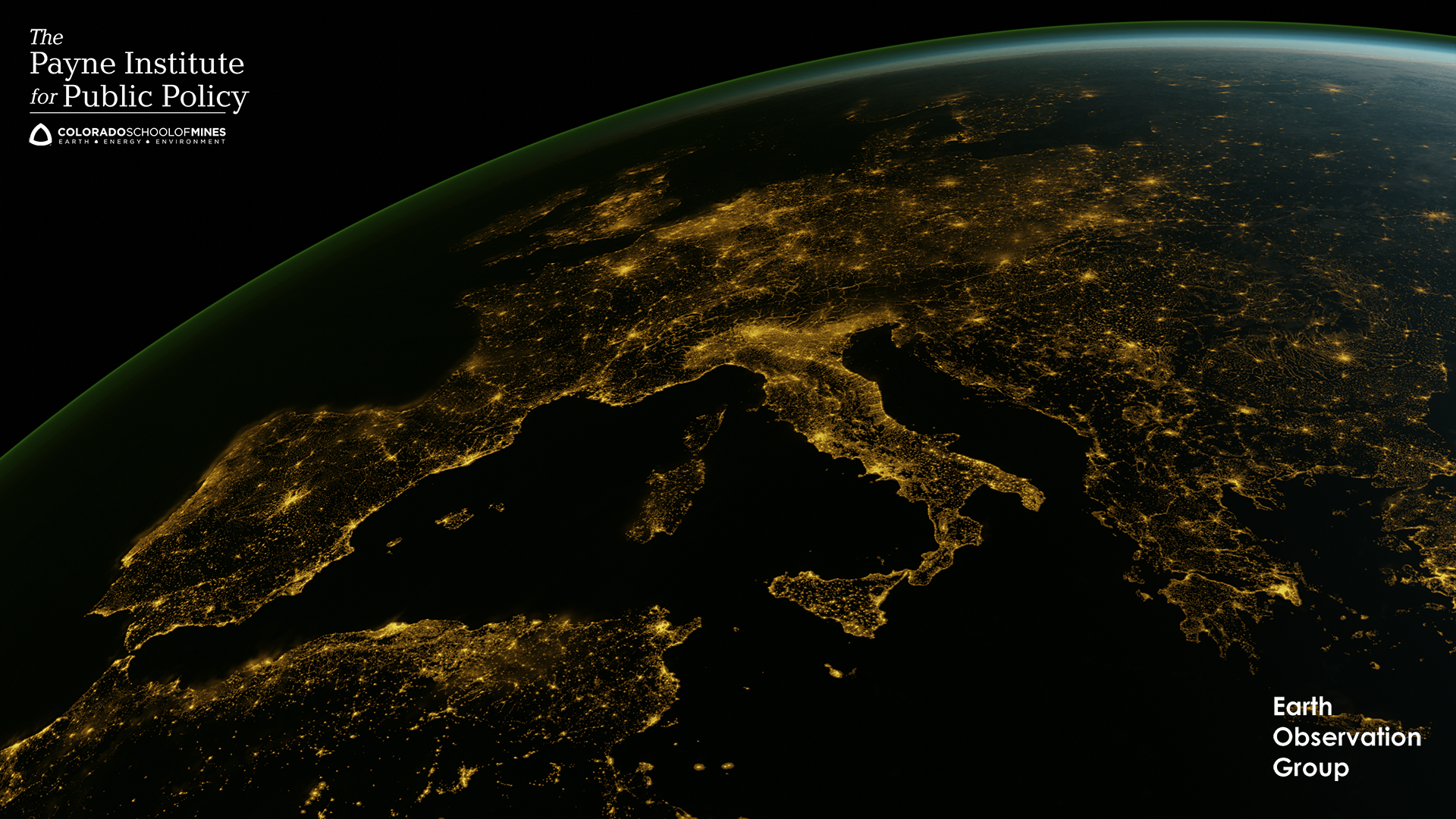
The Earth Observation Group, Payne Institute for Public Policy, Colorado School of Mines.
Urbanization is one of the most significant forms of land-use change. Geospatial datasets provide insights into how cities expand and how population distribution evolves over time.
Selected datasets:
• Global Human Settlement Layer (GHSL)
• VIIRS Nighttime Lights
• LandScan Global Population Database
• WorldPop Spatial Demographic Data
Nighttime lights data, in particular, offers a visually intuitive proxy for human activity and urban intensity. When mapped over time, it reveals patterns of urban growth and regional development.
Earth Observation: Monitoring Environmental Change in Near Real-Time

NOAA/NASA GOES Project
Advances in remote sensing have transformed our ability to monitor the Earth system. Satellite platforms provide continuous, high-resolution data across a wide range of environmental indicators. Complementing satellite data, aerial photographs and orthoimagery offer much higher spatial resolution, enabling detailed analysis at local scales. Orthoimagery (geometrically corrected to remove distortion) are especially useful for accurate measurement and mapping, supporting applications such as land-use classification, infrastructure analysis, and environmental assessment.
Selected datasets:
• MODIS (Moderate Resolution Imaging Spectroradiometer)
• NASA FIRMS (Fire Information for Resource Management System)
• City of Toronto Orthoimagery
These datasets support applications such as wildfire detection, glacier monitoring, air quality assessment, and vegetation analysis. Their temporal frequency allows researchers to track rapid environmental changes as they occur.
Tools and Research Support at the Map & Data Library
At the Map & Data Library, we support students and researchers in accessing and working with these datasets through a range of tools and services.
Core platforms:
• ArcGIS Online and ArcGIS Pro for spatial analysis and cartographic production
• ArcGIS Living Atlas for curated, ready-to-use datasets
• ArcGIS StoryMaps for communicating research through interactive narratives
We also provide guidance on data discovery, GIS workflows, and helping users move from raw data to meaningful analysis.
You can also reach us via help form or by telephone, Monday to Friday, 11am to 5pm, at 416-978-5589.
Conclusion
Mapping is a powerful way to understand environmental change. By integrating diverse datasets from satellite imagery to population grids researchers can uncover patterns, test hypotheses, and inform solutions to global challenges.
This Earth Day, we invite you to explore how geospatial data can support your work. The Map & Data Library is here to help you engage with the data that shapes our understanding of our planet.